

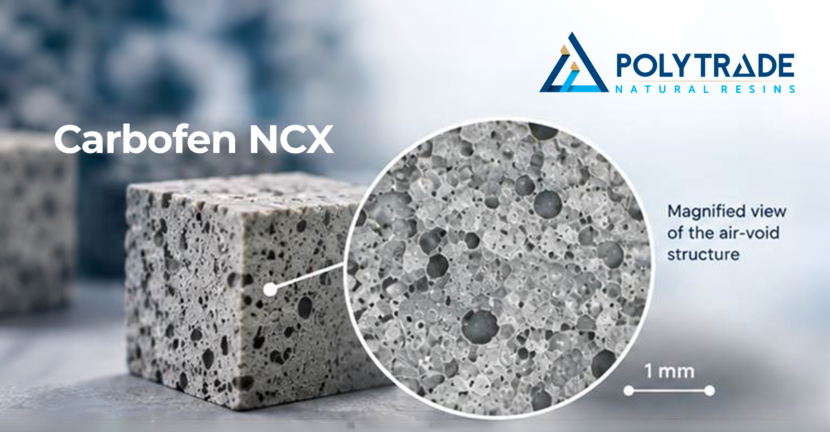
Understanding air entrainment, density reduction, microbubble structure and mechanical performance across lightweight cementitious applications
Lightweight and cellular cementitious materials are increasingly used when reducing density, improving material yield, enhancing workability, or developing thermal and functional properties is important.
But achieving a lower density is not simply a matter of incorporating more air.
The type, size, distribution and stability of air voids can have a significant influence on the final performance of a mortar or concrete. The right air-entraining admixture must therefore be selected according to the formulation, production process, target density, required air content and mechanical performance.
For applications ranging from dry-mix mortar and lightweight mortar to lightweight concrete, microcellular concrete, cellular concrete and ultra-light concrete, air-entraining technology should be treated as a formulation engineering tool, rather than simply a commodity additive.
This is where natural resin-based air-entraining technologies can provide an important formulation advantage.
Why Air Entrainment Matters in Lightweight Cementitious Materials
Air entrainment introduces controlled air voids into cementitious formulations.
In conventional mortar and concrete, controlled air incorporation can improve properties such as:
- Workability
- Plasticity
- Density
- Material yield
- Application characteristics
- Water demand
- Freeze-thaw performance, where applicable
In lightweight and cellular formulations, however, the role of air becomes even more significant.
The air phase can represent a substantial portion of the total volume of the material. As the air content increases, density can decrease, creating opportunities for lightweight and cellular products.
Research on cellular concrete shows that density, air content, formulation parameters and mechanical strength are closely interconnected. The dosage of the air-entraining or foaming technology must therefore be optimized rather than simply maximized.
The key question is not:
“How much air can the admixture generate?”
The better question is:
“How efficiently can the technology create the required air volume while maintaining a stable and controlled cellular structure and the required mechanical performance?”
Not All Air Is the Same
Two formulations can have the same total air content and still behave very differently.
The resulting air-void system can vary according to:
- Bubble size
- Bubble-size distribution
- Bubble spacing
- Bubble stability
- Bubble coalescence
- Air retention during mixing
- Interaction with cement and aggregates
- Mixing energy and mixing time
- Water-to-cement ratio
- Admixture dosage
For hardened concrete, ASTM C457/C457M provides methods for microscopic characterization of the air-void system, including air content, specific surface, void frequency, spacing factor and paste-air ratio.
This reinforces an important formulation principle:
Air content alone does not fully describe the quality of an air-void system.
For lightweight and cellular materials, controlling the structure of the air phase can be as important as achieving the target volume of air.
Choosing the Right Technology for Each Application
The same air-entraining technology should not automatically be used across every cementitious formulation.
The appropriate solution depends on the application.
| Application | Main formulation objective | Key technology requirement |
| Dry-mix mortar | Controlled air, workability and yield | Efficient powder technology |
| Lightweight mortar | Lower density with adequate strength | Controlled air incorporation |
| Lightweight concrete | Density reduction and mechanical performance | Efficient air entrainment and stability |
| Microcellular concrete | High-volume, controlled cellular structure | High air incorporation and bubble stability |
| Cellular concrete | High porosity and controlled density | Cellular structure control |
| Ultra-light concrete | Very low density | High-volume air generation and stability |
This application-driven approach is particularly important when selecting between liquid and powder technologies.
- Dry-Mix Mortar
Dry-mix mortar requires a different approach from ready-to-use liquid formulations.
The additive needs to be compatible with the dry production process and capable of generating the desired air structure after the dry mixture is hydrated.
Typical objectives include:
- Consistent air incorporation
- Improved workability
- Lower density
- Increased mortar yield
- Improved application characteristics
- Controlled mechanical performance
For these applications, powder air-entraining technologies can provide an important processing advantage.
Carbofen NCX for Dry-Mix Mortars
Carbofen NCX is a powder-based natural resin technology developed for applications requiring efficient and controlled air incorporation.
Comparative mortar studies have shown that NCX can efficiently increase entrained air as dosage increases, with particularly strong efficiency after a certain dosage range.
The same technical studies also identified a smaller median air-bubble diameter and more efficient bubble distribution in NCX mortar samples, which was associated with improved compressive-strength behavior at comparable air levels.
This combination makes NCX particularly relevant when the objective is not simply to increase air, but to develop a lighter, productive and mechanically balanced dry-mix mortar.
- Lightweight Mortar
Lightweight mortar is generally designed around a balance between:
Density ↓
while maintaining:
Workability + Strength + Application Performance
Air entrainment can contribute to density reduction and increased mortar yield, but excessive or poorly controlled air can negatively affect mechanical performance.
This makes dosage optimization critical.
Studies with Carbofen NCX demonstrate a strong relationship between air content and compressive strength at both 7 and 28 days. The reported correlations were R² = 0.9296 at 7 days and R² = 0.9881 at 28 days.
The results also indicate that NCX maintained useful compressive-strength behavior at relatively high levels of air incorporation, supporting its investigation in lightweight formulations.
For lightweight mortar, the target should therefore be:
The lowest practical density that meets the required mechanical and application performance.
Not simply the highest possible air content.
- Lightweight Concrete
Lightweight concrete introduces additional formulation variables compared with mortar.
Performance can be influenced by:
- Cement type
- Aggregate type
- Aggregate grading
- Water-to-cement ratio
- Admixture dosage
- Mixing sequence
- Mixing energy
- Air content
- Air-void stability
For this reason, an air-entraining admixture should be evaluated through a complete performance profile rather than by dosage alone.
Recommended evaluation parameters
A technical screening should include:
- Fresh density
- Air content
- Consistency/slump
- Air retention
- Segregation
- 1-day compressive strength
- 7-day compressive strength
- 28-day compressive strength
- Hardened density
- Air-void structure, where appropriate
The importance of the mixing procedure should also not be underestimated. Research has shown that mixing time and admixture dosage can influence the volume and size distribution of entrained air bubbles.
- Microcellular Concrete
Microcellular concrete represents a more specialized application.
Here, the objective is to introduce a substantially higher volume of small air cells while maintaining a sufficiently stable cementitious matrix.
Polytrade has previous development experience in this area.
A dedicated research project developed a stabilized foam technology based on Carbofen NCX and Amida 60 specifically for microcellular concrete. The study compared the Polytrade formulation with MC Muraplast SK 100 and evaluated foam stability, air content, density and compressive strength.
The Polytrade formulation consisted of:
- Carbofen NCX: 18 g
- Amida 60: 2.0 g
- Water: 80 g
The solution was prepared at approximately 4,500 rpm for 30 seconds.
Under the tested conditions, the Polytrade formulation achieved:
- 37.9% air
- 1.367 g/cm³ density
- 6.3 MPa compressive strength at 28 days
The reference formulation achieved 35.8% air, 1.412 g/cm³ density and 6.1 MPa compressive strength.
These results provide an important internal benchmark for Polytrade’s microcellular concrete technology.
What does this mean for NCX?
The existing study validates the Carbofen natural resin technology platform for microcellular concrete, but it should not be interpreted as a direct validation of NCX in this application.
NCX has demonstrated high air-entrainment efficiency in other concrete and mortar studies, making it a strong candidate for further development of powder-based lightweight and microcellular formulations. Direct NCX validation for microcellular concrete remains an area for technical development.
- Cellular Concrete
Cellular concrete is a broader category of lightweight cementitious materials in which a significant proportion of the material volume is occupied by air cells.
The objective is generally to obtain a controlled combination of:
- Low density
- Sufficient compressive strength
- Stable cellular structure
- Workability
- Pumpability or processability
- Thermal or functional performance
Cellular concrete can be produced using different approaches, including preformed foam systems and air incorporation during mixing. The production method has a major influence on the resulting pore structure and properties. (ScienceDirect)
This distinction is important when selecting an admixture.
A technology optimized for conventional air-entrained mortar should not automatically be assumed to perform identically in a high-volume cellular concrete system.
- Ultra-Light Concrete
Ultra-light concrete represents the most demanding end of the density-reduction spectrum.
At very low densities, the air phase becomes a dominant component of the material structure.
The formulation challenge therefore becomes:
How can the formulation generate and retain a very high volume of air without excessive loss of mechanical integrity?
At this point, simply increasing admixture dosage is unlikely to be a sufficient development strategy.
The formulation must be optimized around:
- Target density
- Air volume
- Bubble stability
- Cell-size distribution
- Cementitious matrix strength
- Water content
- Mixing conditions
- Curing conditions
For this reason, ultra-light concrete should be treated as a dedicated formulation-development project rather than as a conventional air-entrained concrete application.
Why Natural Resin Technology Matters
Natural resin-based air-entraining technologies offer an alternative approach to designing controlled air-void systems in cementitious formulations.
Polytrade’s development work with NCX has demonstrated that the technology can efficiently generate air while maintaining favorable mechanical performance in mortar systems.
The technical objective is not simply to maximize air incorporation.
It is to engineer the relationship between:
Air Content → Density → Workability → Yield → Mechanical Performance
This is particularly relevant for lightweight and dry-mix formulations where a small change in air structure can affect several properties simultaneously.
How to Select the Right Air-Entraining Technology
A practical selection process should start with five questions.
- What type of formulation are you producing?
- Dry-mix mortar
- Ready-mix mortar
- Lightweight mortar
- Lightweight concrete
- Microcellular concrete
- Cellular concrete
- Ultra-light concrete
- What is your target density?
The required air volume depends strongly on the desired final density.
- What is your target air content?
Air content should be established based on the application rather than simply maximizing incorporation.
- What mechanical performance is required?
The formulation should be evaluated against the required compressive strength at the relevant curing ages.
- How is the product manufactured?
The technology selection can change depending on whether the formulation is:
- Powder-based
- Liquid-based
- Batch-produced
- Continuously mixed
- Pre-foamed
- Directly air-entrained
Carbofen NCX: A Powder Technology for Lightweight Formulations
Based on the available technical studies, Carbofen NCX is particularly interesting when the formulation requires:
High-efficiency air incorporation
NCX demonstrates efficient air entrainment across dosage levels in mortar and concrete studies.
Controlled microbubble structure
Microscopic analysis in comparative mortar testing identified smaller air-bubble diameter and efficient bubble distribution with NCX.
Lightweight formulations
The relationship between air incorporation and compressive strength makes NCX particularly relevant for formulations where density reduction must be balanced against mechanical performance.
Dry-mix applications
As a powder technology, NCX can be considered for industrialized dry-mix formulations where incorporating the air-entraining technology directly into the dry formulation is advantageous.
From Air Entrainment to Formulation Engineering
The development of lightweight cementitious materials requires a different mindset from simply selecting an air-entraining additive based on price or dosage.
The most effective approach is to start with the desired final performance.
Define the target
Density → Air Content → Strength → Workability → Production Process
Then select the appropriate technology.
This is why the right air-entraining admixture is not necessarily the one that generates the most air.
It is the one that provides the right air structure for the formulation’s performance requirements.
Polytrade Approach: Beyond Air Entrainment
At Polytrade, we develop natural resin technologies for cementitious formulations with a focus on controlled air incorporation and overall formulation performance.
Our approach is based on understanding the customer’s:
- Application
- Production process
- Target density
- Air-content requirements
- Mechanical performance
- Workability requirements
- Formulation economics
From there, the appropriate technology can be selected and optimized.
For dry-mix and powder-based formulations, Carbofen NCX provides a particularly interesting platform for developing lightweight and high-yield formulations.
For more specialized microcellular and cellular concrete applications, Polytrade’s previous Carbofen Resin-based development provides an important technical benchmark for further formulation development.
Frequently Asked Questions
What is the best air-entraining admixture for lightweight mortar?
There is no universal best product. The appropriate technology depends on the target density, air content, strength, workability and production process. Carbofen NCX is particularly relevant for powder-based lightweight mortar formulations because of its high air-entrainment efficiency and favorable air-content/compressive-strength relationship.
Can Carbofen NCX be used in dry-mix mortar?
Yes. NCX is a powder air-entraining technology and is particularly suited for investigation in dry-mix mortar formulations. Its technical studies demonstrate efficient air incorporation and favorable bubble characteristics in mortar systems.
Can air-entraining admixtures reduce concrete density?
Yes. Incorporating controlled air increases the volume of air within the cementitious matrix and can reduce material density. However, the target air content must be optimized because excessive air can affect mechanical performance.
Can NCX be used for lightweight concrete?
NCX has demonstrated air-entrainment performance in concrete and favorable relationships between air content and mechanical performance, making it a strong candidate for lightweight concrete development. Specific dosage and performance must be established for each concrete formulation.
Is NCX validated for microcellular concrete?
NCX has not yet been directly validated in the available microcellular concrete study. Polytrade has, however, demonstrated microcellular concrete performance using a Carbofen Resin-based technology, achieving 37.9% air, 1.367 g/cm³ density and 6.3 MPa compressive strength at 28 days. This provides an internal benchmark for further NCX development.
What is the difference between lightweight concrete and cellular concrete?
Lightweight concrete is a broad category of concrete with reduced density. Cellular concrete is a type of lightweight cementitious material in which a significant portion of the volume is occupied by controlled air cells. Cellular concrete can therefore involve substantially higher air volumes than conventional lightweight concrete. (ScienceDirect)
What should be measured when developing cellular concrete?
At minimum, development should consider fresh air content, fresh and hardened density, consistency, compressive strength and air stability. For advanced characterization, microscopic analysis of the hardened air-void system can provide information about air content, bubble distribution, spacing and specific surface. ASTM C457/C457M is a relevant reference for this type of air-void characterization. (ASTM Store)
Conclusion
Selecting an air-entraining admixture for lightweight and cellular cementitious materials requires more than comparing dosage or price.
The right technology must be matched to the application, target density, air content, production process and required mechanical performance.
For dry-mix and lightweight mortar applications, Carbofen NCX offers a powder-based natural resin technology with demonstrated high air-entrainment efficiency and favorable mechanical performance.
For microcellular and cellular concrete, Polytrade’s previous development work demonstrates the potential of natural resin-based technology to create high-volume, controlled air structures, providing a valuable benchmark for further development.
The next generation of lightweight cementitious materials will not be defined simply by how much air is incorporated, but by how effectively that air is engineered within the formulation.
The goal is not maximum air.
The goal is controlled air for optimized performance.